Crowds filling the courtyard of Gangtey Goenpa in Bhutan's Phobjikha valley for the valley's annual crane festival

Winter wildlife journey · 7 nights

The Cranes of Phobjikha

Winter with the black-necked cranes: frosty dawns above the Phobjikha roost, then warm Punakha to finish.

  • 7nights, private
  • 4bases
  • 3,250 mhighest point
  • ₹8,25,000from, per person, twin share

In short

Is The Cranes of Phobjikha right for you?

The Cranes of Phobjikha is a private seven-night winter journey in Bhutan, built around the black-necked cranes. You fly into Paro, spend a night each in Paro and Thimphu, three in the Phobjikha valley above the roost and two in warm Punakha, then fly out of Paro.

Made forbirders and wildlife photographers, couples who like cold, quiet places, families with children over 10 who can sit still at dawn and returning visitors who want Bhutan out of season.

Not for you iffrost at 06:00 and short winter days sound like hardship, travel in spring on A Bhutan Honeymoon or Bhutan: The Western Valleys instead.

Every autumn black-necked cranes cross the Himalaya from the Tibetan Plateau and come down into Phobjikha, a broad bowl of marsh and farmland at about 2,900 m in central Bhutan. They come down as autumn ends and stay the winter. By night they stand in the shallow marsh; at first light they lift off, calling, to feed in the fields. The valley has made room for them. Its power cables run underground, its wetland has been a Ramsar site since 2014, and farmers here traditionally wait for the cranes before sowing winter wheat. Local tradition says the birds circle Gangtey Goenpa three times when they come and again when they go.

This journey keeps the cranes' timetable rather than a sightseer's. You get three dawns in the valley, because fog or snow can take any one of them, and a lodge built as a bird-watching bridge above the marsh. Winter is Bhutan's quiet season: dry, bright days, frost at 06:00, few other travellers. Even the warm ending follows the season, because the chief abbot and his monks winter in Punakha too.

Length
7 nights, 8 days
Starts and ends
Paro airport to Paro airport
Best months
November to mid February
Avoid
late February to October, when the cranes are back on the Tibetan Plateau; mid June to mid September is also monsoon
Pace
Moderate
Longest drive
About 4.5 hours, 490 km in all
Highest point
Lawa La, 3,250 m
Group
Private, 2 to 6 guests

The route

Why Paro comes first

Paro and Thimphu come first because the airport is in Paro and both towns sit lower than the crane valley: a night at 2,300 m and one at 2,320 m before three near 2,900 m. Three nights in Phobjikha buy three dawns, and you will want the spare. Punakha comes last because it is warm and low at 1,200 m, and only about four hours from Paro airport, which suits the 16:20 winter departures.

Jomolhari 7,326 m Paro airport 1 Paro · 1 night 2 Thimphu · 1 night 3 Gangtey (Phobjikha valley) · 3 nights 4 Punakha · 2 nights
your bases, in orderby roadborders not drawn

Where the nights go

Read the place guidesBhutan

The shape of the journey

From 1,250 m to 3,250 m, day by day

You sleep between 1,250 m and 2,900 m. The highest you go is 3,250 m, on day 3 at Lawa La, and you come down again to sleep.

Built around

Paro, Thimphu, Gangtey (Phobjikha valley) and Punakha at their best

  • Three dawns above the roost, with a spotting scope set up before the cranes lift off the marsh

  • A lodge above the crane centre, built as a bird-watching bridge, with binoculars in every suite

  • Taktsang in dry winter light, with ice grips in the car and an 08:00 start

  • The Black-necked Crane Festival in Gangtey Goenpa's courtyard on 11 November; ask us to build your dates around it

  • Punakha at 1,200 m, where the chief abbot and his monks also spend the winter

  • A tented villa with its own heated pool above the Mo Chhu, after three frosty mornings

Day by day

Day by day, Paro to Punakha

The longest drive is day 3, Thimphu to Gangtey (Phobjikha valley), about 4.5 hours with stops.

  1. Day 1 · Paro airport Paro

    Paro in low winter sun

    • 12 km, about 0.5 h
    • High point 2,300 m
    • Sleep at 2,300 m
    • Easy
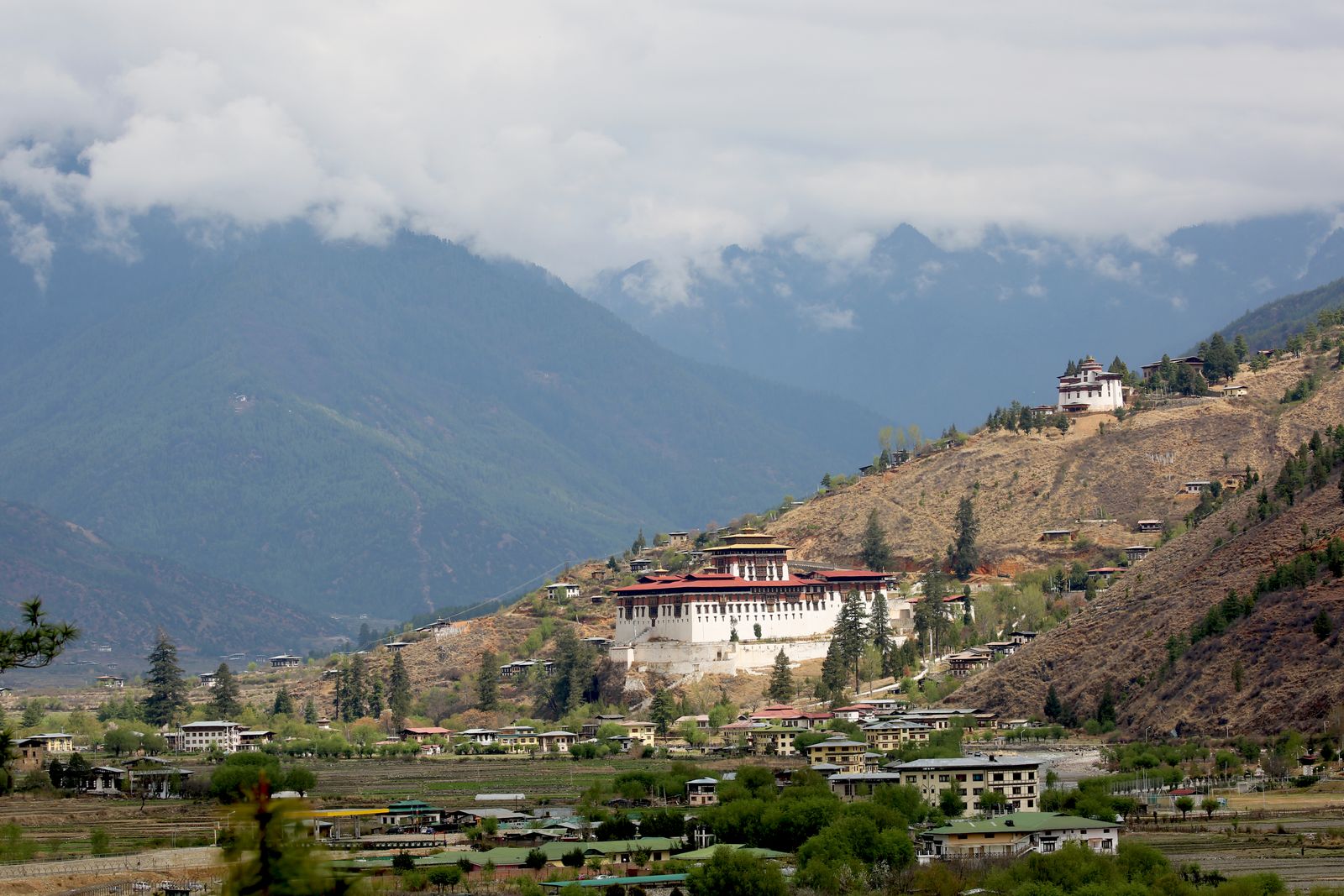
    Rinpung Dzong above Paro town with the round Ta Dzong higher on the dry hillside, cloud low over the ridges

    The Bagdogra flight touches down at 10:40 on Tuesdays and Saturdays in December and January, and at 11:00 in November; the Delhi flight arrives at 15:20 every day. Your guide meets you at the arrivals exit, and COMO Uma Paro is ten minutes away on its pine hill. Before anything else we check your winter kit: the car carries spare down jackets, gloves, hand warmers and hot water bottles, and anything missing is lent for the week. Rest, and have tea. At 14:30 your guide walks you through Rinpung Dzong and down to its covered bridge as the low winter sun turns the whitewash gold; off the Delhi flight, you go straight to the bridge for that light instead. Paro is cold after dark in winter, so dinner is at the lodge's Bukhari restaurant, named after the Bhutanese wood stove. Early to bed: tomorrow is Taktsang.

    The momentRinpung Dzong turning gold and then grey as the winter sun drops behind the ridge a little after 17:00

    InsiderWinter Paro means quiet streets by 18:00 and hard frost by midnight. We book dinner at the lodge for that reason, and ask housekeeping to warm the room early.

    If the weather turnsIf weather delays your flight, we track it with Drukair, tell the lodge when to serve dinner, and fold Rinpung Dzong into tomorrow afternoon on the way to Thimphu.

    Meals
    Dinner
  2. Day 2 · Paro Thimphu

    Frost on the Taktsang path, Thimphu by dark

    • 85 km, about 2 h
    • High point 3,120 m
    • Sleep at 2,320 m
    • Active
    Taktsang monastery on its granite cliff above Paro after fresh snow, white walls bright against a hard blue sky

    We start at 08:00, later than in autumn, because the sun reaches the Taktsang path late in winter and its shaded upper steps can hold ice until mid-morning. From December the car carries slip-on ice grips for everyone, and your guide carries a flask of suja, salted butter tea. The climb itself, in figures, is set out on /destinations/bhutan/#taktsang. What winter changes is the light. The air is dry, the pines are dark, and the white monastery stands out hard against a blue that autumn rarely gives. Your guide times the visit to be back through the gate before the midday closure, so the descent is in full sun and the ice has softened. Lunch at the cafeteria or in the valley, then at 15:00 the car takes the river road east, an hour and a half to Pemako Thimphu, reached before dark. A hot bath and an early night before the long road east.

    The momentHands round a cup of butter tea at the cafeteria, the monastery bright white on its cliff against a hard winter sky

    InsiderSunset in Paro falls around 17:10 in December. Starting at 08:00 and heading down by 13:00 keeps the whole descent in daylight, with hours in hand.

    If the weather turnsIf ice or fresh snow closes the upper path, we stop at the cafeteria viewpoint, which faces the monastery, and add Kyichu Lhakhang before the Thimphu drive.

    Meals
    Breakfast, Lunch, Dinner
  3. Day 3 · Thimphu Gangtey (Phobjikha valley)

    Across Dochu La to the crane valley

    • 140 km, about 4.5 h
    • High point 3,250 m
    • Sleep at 2,900 m
    • Easy
    The 108 Druk Wangyal chortens at Dochu La under fresh snow, the pass bright beneath a blue winter sky

    At 07:30, the white Memorial Chorten, where Thimphu's elders walk their circuits in heavy winter gho and kira before breakfast. Leave at 08:30 and cross Dochu La, 3,100 m, while the winter morning is at its clearest; on 13 December the pass holds its own festival among the chortens. Down to Wangdue for lunch, then east and up: about 3 km short of Pele La the road turns over Lawa La, 3,250 m, and drops into Phobjikha, 135 km from Thimphu. We aim to reach Six Senses Gangtey by 15:30. At 16:30 you stand in the lodge's bridge building with a scope as the cranes fly in from the fields to roost, calling as they drop onto the marsh.

    The momentThe first calls of the trip, carried across the frozen valley as the cranes drop into the marsh at dusk

    InsiderJoin the elders at the Memorial Chorten, always clockwise. At 07:30 in winter it is mostly regulars in their warmest clothes, and nobody minds a visitor alongside.

    If the weather turnsIf fresh snow shuts Lawa La, we wait in Wangdue until the road opens, or sleep in Punakha and cross next morning, losing an evening in the valley, not a dawn.

    Meals
    Breakfast, Lunch, Dinner
  4. Day 4 · Gangtey

    Dawn at the roost

    • 10 km, about 0.5 h
    • High point 3,000 m
    • Sleep at 2,900 m
    • Moderate
    A wide glacial valley floor of marsh and fields in central Bhutan, farmhouses scattered below cloud on the ridges

    06:15, well below freezing. The car is warm at the door with hot water bottles on the seats, and your guide takes you a few minutes down to a viewpoint behind the fences at the marsh edge, the scope set up before sunrise, which comes at about 06:40 in December. The cranes stand in the shallow water, heads tucked under their wings: grey birds 139 cm long with a black head and neck, a bare red crown and a small white patch behind the eye, the young of the year standing beside their parents. As the sun catches the western ridge they stir, call, and lift off in family groups on wings 2.35 m across, heading for the fields. Each family keeps its own patch of marsh or field through the winter. Breakfast at 08:00. The middle of the day is for the Black-necked Crane Visitor Centre, run by the Royal Society for Protection of Nature: telescopes over the marsh and a short film on the migration from Tibet. After lunch, Gangtey Goenpa, founded in 1613 by Pema Lingpa's grandson and the seat of his line; in January and February many of its gomchen winter lower down and the halls are quieter. Dinner by the lodge's fire pit.

    The momentThe roost lifting off the marsh in family groups, bugling, as the first sun touches the western ridge

    InsiderThe birds spend nearly three quarters of the day feeding, hardest at dawn and dusk. We build every Phobjikha day around that clock, keeping the middle hours for the centre, the monastery and lunch.

    If the weather turnsIf fog hides the roost at dawn, we return at 16:00 for the evening fly-in and try dawn again on day five or six; three mornings are planned for exactly this.

    Meals
    Breakfast, Lunch, Dinner
  5. Day 5 · Gangtey

    Farm tracks, a farmhouse fire and a stone bath

    • 10 km, about 0.5 h
    • High point 3,000 m
    • Sleep at 2,900 m
    • Moderate
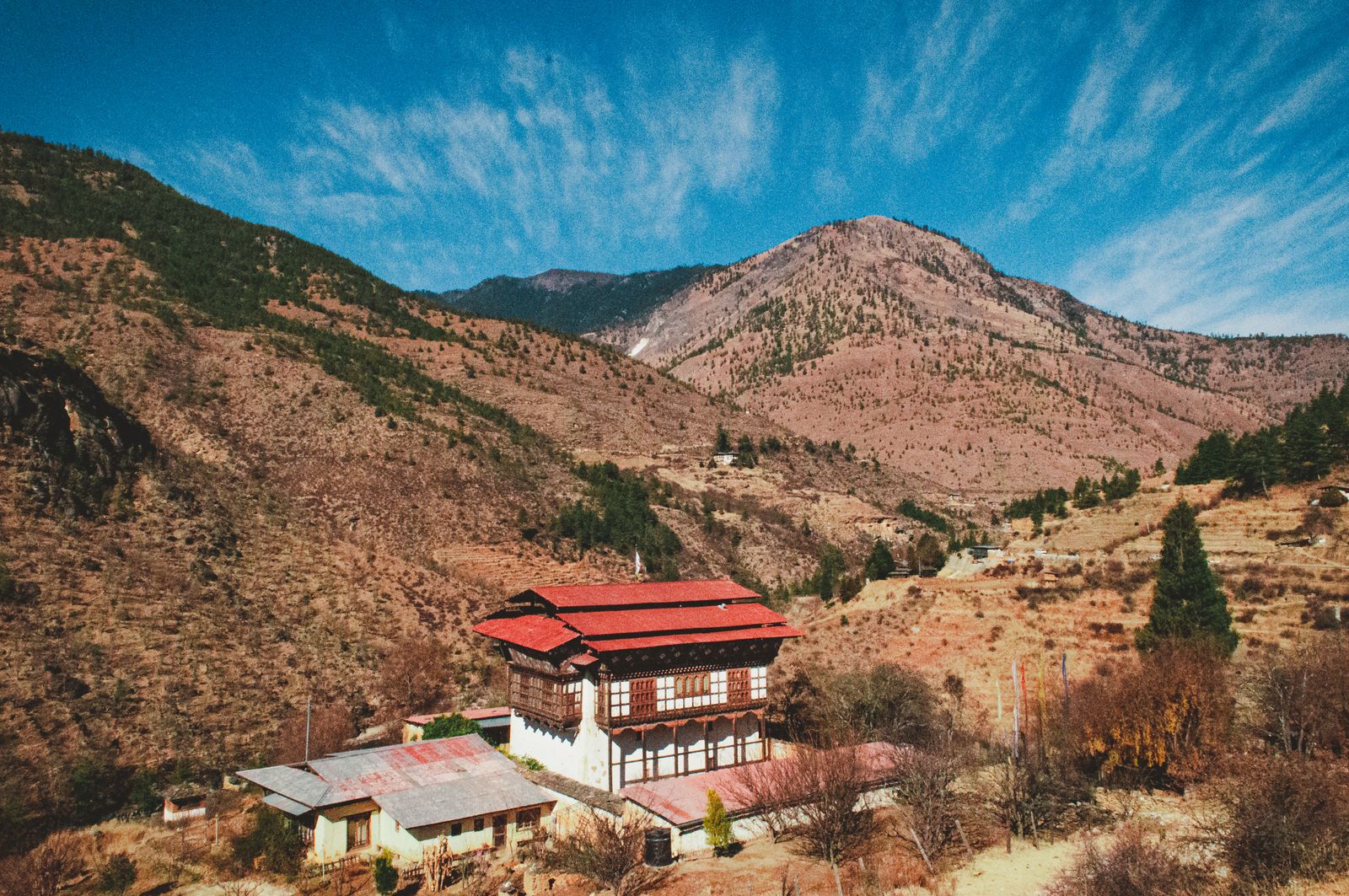
    A Bhutanese farmhouse with a red roof and carved wooden windows on a dry winter hillside under a blue sky

    No alarm unless you want one: the binoculars in your suite cover the marsh from the balcony, blanket round your shoulders. At 09:30, with the frost lifting, your guide walks you along farm tracks at the valley's edge, staying behind the fences that keep people off the roosting ground. Winter here is hard enough that some Phobjikha families move to warmer valleys in January and February. Lunch at 12:30 is in the kitchen of a family that stays through the cold: red rice, a mild ema datshi, suja by the stove. Then the dotsho. River stones have been in the family's fire since mid-morning; they go into a wooden tub of water scented with khempa leaves, and you soak while the chimney smokes against the cold. At 16:00 we find a new viewpoint for the evening fly-in. If your dates include 11 November, the crane festival fills Gangtey Goenpa's courtyard with schoolchildren dancing as cranes.

    The momentLowering yourself into stone-heated water in a wooden tub while the farmhouse chimney smokes against the frost

    InsiderDotsho stones need hours in the fire to heat through, so we ask the family to light it at mid-morning. You arrive to water already at the right heat.

    If the weather turnsIf snow falls, the walk shrinks to the lodge side of the valley and we drive the ten minutes to the farmhouse; lunch and the bath go ahead as planned.

    Meals
    Breakfast, Lunch, Dinner
  6. Day 6 · Gangtey Punakha

    Last light in Phobjikha, then down to warm Punakha

    • 78 km, about 3 h
    • High point 3,250 m
    • Sleep at 1,250 m
    • Easy
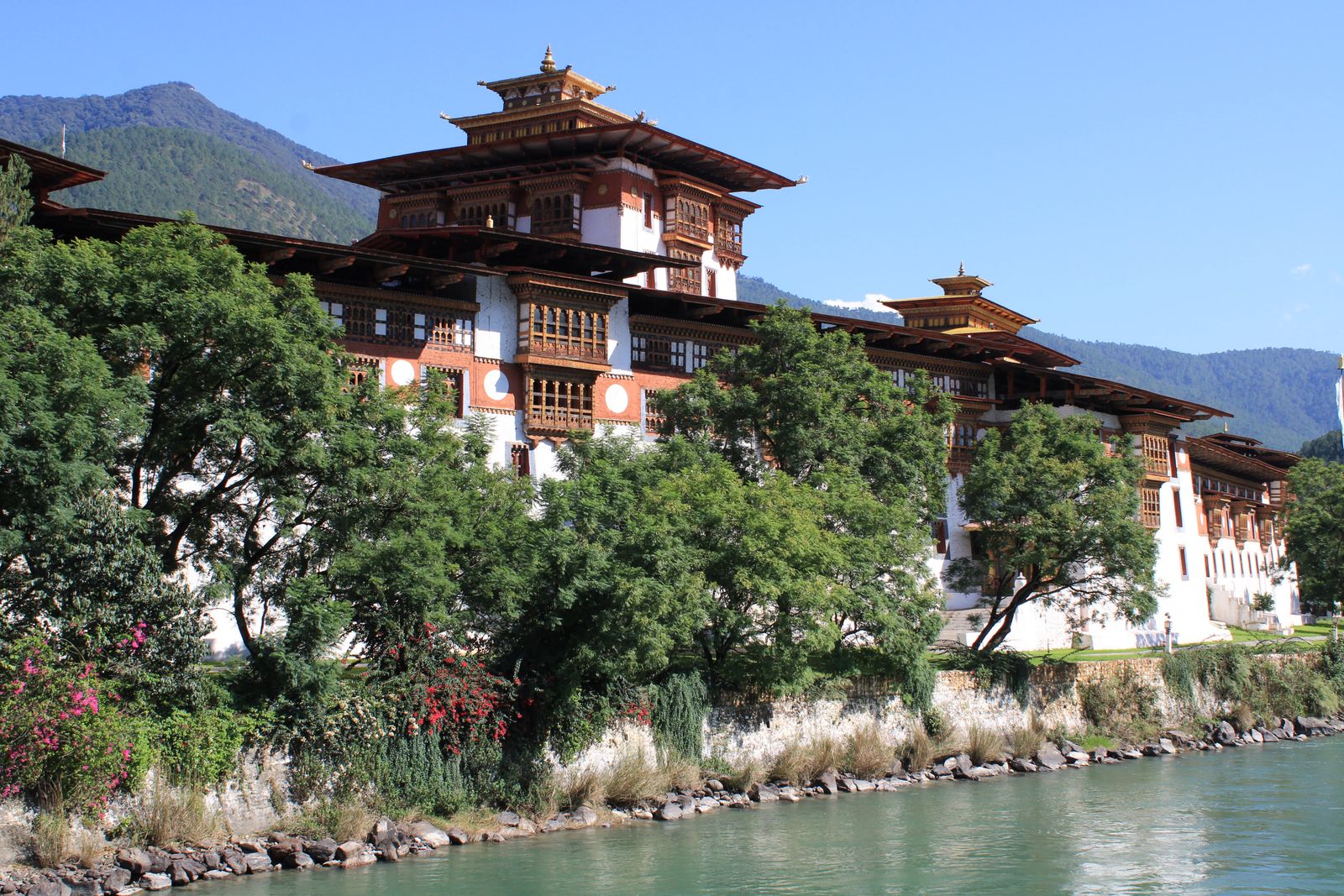
    Punakha Dzong at the meeting of two rivers in Bhutan

    One last dawn at 06:15 if you want it; if the first two were clear, sleep in and watch from the balcony. Leave at 10:00, back over Lawa La and down past Wangdue, and watch frost give way to orange trees and rice stubble as you lose some 1,650 m. Pemako Punakha's tented villas sit in pine forest on a hillside above the Mo Chhu; lunch is at its Alchemy House. At 15:00 you walk into Punakha Dzong in the one season it is fullest: the Je Khenpo and the central monk body have come down from Thimphu for the cold months, so the courtyards are busy with maroon robes and the sound of chanting. Cross back over the covered bridge at dusk. Your villa has its own heated pool, and tonight the steam rises off it into the valley air.

    The momentSwimming in your own heated pool under the first stars, 1,650 m below the frost you woke up in

    InsiderMonks and cranes keep the same calendar here. Both come down for the cold months: the birds to Phobjikha, the abbot and his monks to Punakha.

    If the weather turnsIf Lawa La is icy at 10:00, we wait for sun on the road; the drive is three hours, so a noon start still reaches Punakha Dzong by mid-afternoon.

    Meals
    Breakfast, Lunch, Dinner
  7. Day 7 · Punakha

    A chorten above the Mo Chhu and a slow afternoon

    • 30 km, about 1 h
    • High point 1,400 m
    • Sleep at 1,250 m
    • Moderate
    The Mo Chhu winding through golden paddy fields in the upper Punakha valley, forested ridges rising on both sides

    Breakfast outside if you like: Punakha's winter sun is warm by mid-morning in a way Phobjikha's never is. At 09:30 the car runs half an hour up the Mo Chhu; you cross the river on a footbridge and climb about 30 minutes through bare winter terraces to Khamsum Yulley Namgyal Chorten. Its four floors hold mandala deities, and from the roof the whole valley lies below you, its paddy cut to gold stubble. Back for lunch at Pemako. The afternoon is slow on purpose: the Lotus Realm spa, a book on your deck, or the 20-minute field walk from Sopsokha to Chimi Lhakhang, the temple of Drukpa Kunley. For the last dinner we ask the Alchemy House kitchen for jasha maru, a Bhutanese chicken dish, with red rice and a small cup of ara, the local rice wine.

    The momentBreakfast outside in warm sun, two mornings after the frost of the Phobjikha dawns

    InsiderPunakha's winter sun is strong by 10:00 and gone fast after 16:00. Carry sunglasses up to the chorten and keep the down jacket in the car for the evening.

    If the weather turnsIf rain comes, we swap the chorten climb for a second, quieter visit to Punakha Dzong and the spa, and keep the farewell dinner exactly as planned.

    Meals
    Breakfast, Lunch, Dinner
  8. Day 8 · Punakha Paro airport

    Back over the pass to Paro and the afternoon flight

    • 125 km, about 4 h
    • High point 3,100 m
    • Easy
    Gilded finials of the Dochu La chortens against evening cloud, blue ridges stretching away to the north

    Breakfast at 08:00, leave at 09:00. We match this day to Drukair's 16:20 departures from Paro in winter: to Bagdogra on Mondays and Fridays, to Guwahati on Thursdays and Sundays, and to Bangkok on the other days. Day eight falls on the same weekday as your arrival, so a Monday or Friday start ends with the Bagdogra flight and a Thursday or Sunday start with Guwahati; guests who fly in on the Bagdogra flight, which lands on Tuesdays and Saturdays, add the Paro night below, because the 09:40 to Delhi cannot be reached from Punakha. The road climbs back to Dochu La by about 10:45 for a last look north, then runs down past Thimphu to Chuzom and up the Paro valley, about four hours in all. Lunch at 13:00 in Paro, then the airport at 14:15, two hours before departure. Your guide sees you to the terminal door. We track the flight from Darjeeling, and if you are heading into the hills, our driver waits for you at the Bagdogra arrivals exit.

    The momentA last look north from Dochu La, the chortens behind you and the peaks sharp in the dry winter air

    InsiderWe watch your inbound aircraft from noon. If it is running late, you hear it from us over lunch, not at the check-in desk.

    If the weather turnsIf fog or snow closes Paro, we find you rooms at COMO Uma Paro, rebook the next departure to your city and move any onward connection for you.

    Tonight
    Homeward
    Meals
    Breakfast, Lunch

Where you will stay

Where you sleep, four houses

COMO Uma Paro, Pemako Thimphu, Six Senses Gangtey and Pemako Punakha. Prefer a different house on any night? Say which and we re-price it.

  1. A Bhutanese building among pines on a hillside above the Paro river and the town of Paro
    The pine hillside over the Paro river and valley that the hotel looks down on.Thinho 7 / Pexels
    1 night

    COMO Uma Paro

    Paro

    Ten minutes from the airport on a pine hill, with the Bukhari restaurant fed by its kitchen garden: right for a first night when flights run late.

    Ask for Valley Room, for the view over the Paro valley; Forest Rooms look into the pines

    • Getting inForest Rooms are on the main floor close to the lobby
    • BathroomValley Rooms have a bathtub with a separate shower stall; Forest Rooms have a walk in shower only
  2. The ochre and timber front of the hotel in Thimphu built as the Taj Tashi, now Pemako Thimphu
    The house itself in central Thimphu, photographed while it still traded as the Taj Tashi.Christopher J. Fynn, CC BY-SA 4.0, via Wikimedia Commons
    1 night

    Pemako Thimphu

    Thimphu

    Central, warm and quick to leave: the Memorial Chorten is minutes away at 07:30, and the road east starts at the edge of town.

    Ask for Deluxe Room; ask for one with a bathtub for the evening after Taktsang

  3. The Phobjikha valley floor in Bhutan, fields and white farmhouses below pine covered ridges
    The Phobjikha valley from the pine ridge above it, the ground the binoculars are turned on.Prof. Mortel, CC BY 2.0, via Wikimedia Commons
    3 nights

    Six Senses Gangtey

    Gangtey

    Eight suites directly above the RSPN crane centre, with private balconies and binoculars in every room.

    Ask for Lodge Suite, valley-facing, with a private balcony and a central bukhari, all meals included

  4. Punakha Dzong standing white and red above the green river water in western Bhutan
    Punakha Dzong on the water downstream, the same river the tented villas stand above.Nilanjan Haldar / Pexels
    2 nights

    Pemako Punakha

    Punakha

    Tented villas on a forested hillside above the Mo Chhu, each with a private heated pool: warmth and space after three frosty dawns.

    Ask for Luxury Tented Pool Villa, breakfast and dinner included

Price and what it covers

from₹8,25,000

per person, twin share, on December to February dates, for Indian nationals with seven nights of SDF, ₹8,400; November, high season at Six Senses, costs about ₹95,000 more. How our prices are built

About £6,430 or US$8,590 at the rates of 19 September 2026.

On other passports, about ₹8,88,000 (£6,930, US$9,250). Bhutan's Sustainable Development Fee is US$100 a night for most visitors, against ₹1,200 for Indian passports, for 7 nights here, plus a US$40 visa. How the fee works

Included

  • One night at COMO Uma Paro, one at Pemako Thimphu, three at Six Senses Gangtey on full board and two in a Pemako Punakha pool villa, with breakfast and dinner throughout and lunch from day 2
  • Your own Prado-class SUV and Bhutanese driver from Paro airport back to Paro airport, or a Toyota Hiace for a party of five or six
  • A licensed Bhutanese guide throughout, who carries a spotting scope, and a pair of binoculars for each guest
  • Your Bhutan entry permit, or the US$40 online visa for other passports, filed by us from your scans
  • The Sustainable Development Fee for your seven winter nights, ₹1,200 a night for Indian nationals (other passports: /plan/what-it-costs/#bhutan-sdf)
  • Monument entry fees at the rate for your passport, including Taktsang, Rinpung Dzong, the Memorial Chorten and Punakha Dzong, and the crane centre
  • Farmhouse lunch and a dotsho hot stone bath in Phobjikha on day 5
  • Winter kit in the car: spare down jackets, gloves, hand warmers, hot water bottles and slip-on ice grips for the Taktsang path
  • A local SIM card with data for each guest
  • Our office in Darjeeling on call 24x7 through your winter week

Not included

  • Flights into and out of Paro, which we book around the 16:20 winter departures
  • Non-Indian passports: US$100 a night in SDF and the US$40 visa, about ₹63,000 more each
  • Travel and medical insurance, including winter weather delays
  • Tips for your guide and driver
  • Bar drinks beyond each lodge's rate, and spa treatments
  • Camera equipment, laundry and personal expenses
  • The optional add-ons below

Make it more Arranged on request, priced in your quote

  • A fourth dawn in the valleyOne more night at Six Senses Gangtey, worth having in January when fog can sit on the marsh for a morning or two.
  • A night in Paro before you flyAdds a night at COMO Uma Paro so you can take the 09:40 flight to Delhi, or any morning departure, without a dark start.
  • Butter lamps at Gangtey GoenpaWe arrange an offering of butter lamps at the monastery, lit for your family before you leave the valley.
  • Winter nights in the Darjeeling hillsTake the Monday or Friday flight to Bagdogra, and our driver brings you up for three clear winter nights of tea and Kanchenjunga.

Before you go

Before you go on this route

Choose another journey ifIf frost at 06:00 and short winter days sound like hardship, travel in spring on A Bhutan Honeymoon or Bhutan: The Western Valleys instead.

  1. Papers: Indian guests need an original passport or voter ID, and Aadhaar will not do; we need scans three weeks out. Documents for children and other nationalities are listed on /plan/permits-and-visas/#documents.
  2. Clothing for dawn: Phobjikha falls well below freezing overnight and snow is possible in January and February. Bring a down jacket, thermal layers, a warm hat, thin gloves you can work a camera in, and insulated boots.
  3. Optics: binoculars travel with you and every Six Senses suite keeps a pair, so bring your own only if you prefer them (8x42 suits most people). For photographs, a lens of 300 mm or longer, and your guide carries a spotting scope.
  4. Crane manners: stay behind the marsh fences even when the birds seem close, because the roost is protected ground. Keep voices low and flash off. Visitors may not fly drones anywhere in Bhutan, and customs at Paro keeps any that arrive until you leave.
  5. Altitude: three nights at about 2,900 m follow two lower ones. A mild headache on the first evening is common; drink water and go easy on alcohol.
  6. Winter cash: small rupee notes for butter lamps and the farmhouse; a Bhutanese SIM waits in the car, since Indian roaming fails in the valley. Fees and tips are explained on /plan/what-it-costs/#bhutan-sdf and /plan/before-you-travel/#tipping.

Questions

Six questions about The Cranes of Phobjikha

Ask on WhatsApp
When do black-necked cranes arrive in Phobjikha?

They arrive in late October and leave by mid-February, flying in from the Tibetan Plateau. Numbers build through November, and December and January are the steadiest months to see them. The 2024 to 2025 count recorded 640 cranes in Phobjikha, including 75 juveniles, out of 709 across Bhutan. We run this journey from November to mid-February.

What happens at the Black-necked Crane Festival?

It is held every year on 11 November, the birthday of the Fourth King, Jigme Singye Wangchuck, in the courtyard of Gangtey Goenpa. The Royal Society for Protection of Nature began it in 1998 to welcome the birds back and to teach their protection. Schoolchildren dance in crane costumes, and there are mask dances and songs. It draws more visitors than any other day of the season, so on November dates we build your Phobjikha nights around it.

Why Phobjikha and not Bumdeling?

Phobjikha, in Wangdue Phodrang district, holds most of Bhutan's wintering cranes, and it has the RSPN visitor centre with telescopes over the marsh and a lodge built to watch the roost. Bumdeling, in the far east, had 59 birds in the same count and is a long way from any airport. For a week's journey out of Paro, Phobjikha is the answer.

Six Senses Gangtey or Gangtey Lodge?

Both look across the valley. Six Senses Gangtey has eight suites directly above the RSPN crane centre, a main building made as a bird-watching bridge, binoculars in every suite and every meal included, which is why we chose it for three dawns. Gangtey Lodge, at the head of the valley, has twelve suites with wood stoves facing Gangtey Goenpa and costs markedly less. Ask us to price the journey both ways.

Can you climb the Tiger's Nest in winter?

Yes. The trail stays open through winter and the air is usually dry and clear, but the shaded upper steps can be icy in December and January. We start at 08:00 once the sun is on the path, carry slip-on ice grips, and turn at the cafeteria viewpoint if the guide judges the steps unsafe. The climb's figures and rules are on our Taktsang card at /destinations/bhutan/#taktsang.

Can children or older guests manage the dawns?

Usually, because the dawns ask for patience rather than effort. The car is warm at the door at 06:15, the viewpoint behind the marsh fences is a few minutes away, and hot water bottles and spare down jackets travel with you. Children over ten who can sit still and quiet do best. With three dawns planned, anyone can sleep through one and watch from the balcony. The real test is the cold: nights well below freezing at about 2,900 m.

Sources we checked for this itinerary (38)
  1. Phobjikha: about 970 hectares declared a Ramsar site on 2 May 2014; valley given as about 3,000 m; underground power cables; cranes arrive late October and leave mid February; some residents, including monks of Gangteng, move to Wangdue for January and February; crane festival 12 November (page read again 20 September 2026)
  2. RSPN, the society that runs the crane centre, dates the Gangtey-Phobji Ramsar listing to June 2016, Bhutan's third
  3. Cranes circle Gangteng Monastery three times on arrival and departure; communities plant winter wheat after the cranes arrive; festival on 11 November; roost in marshes at night
  4. 2024 to 2025 count: 709 cranes in Bhutan, 640 in Phobjikha including 75 juveniles, 59 in Bumdeling
  5. Black-necked crane 139 cm long, wingspan 235 cm, grey with black head and neck, red crown, white patch behind the eye; Near Threatened; nearly 75 percent of the day foraging, peak early morning and late afternoon; winter family groups keep their own feeding territories
  6. Black-necked Crane Visitor Centre, RSPN: open 09:00 to 17:00 with a lunch break, telescopes and a film on the migration
  7. Gangteng Monastery founded 1613 by Gyalse Pema Thinley, seat of the Pema Lingpa tradition, kept by gomchen lay monks
  8. Six Senses Gangtey: eight suites and one villa, directly above the crane conservation centre, main building a traditional bird-watching bridge, fire pit
  9. Six Senses Gangtey at 2,900 m: eight suites and a villa with private balconies, in-room binoculars and a central bukhari
  10. Six Senses Gangtey 2026-27 seasons (low season June to August and December to February) and Lodge Suite rates on full board, secondary source
  11. COMO Uma Paro seasons (regular: January, February, June to August, December) and 2026-27 room rates with breakfast and dinner
  12. COMO Uma Paro ten minutes from Paro airport; Bukhari restaurant and organic kitchen garden
  13. Pemako Punakha: tented pool villas on a forested hillside above the Mo Chhu; Alchemy House restaurant
  14. Pemako Punakha Luxury Tented Villa with a private heated pool, half board; 2025 room rates
  15. Pemako Punakha official: Luxury Tented Pool Villa with private heated pool; Alchemy House, Lotus Realm Spa; taking bookings
  16. Taj Tashi renamed Pemako Thimphu in 2023
  17. Drukair December 2026: Bagdogra to Paro 09:40 to 10:40 Tuesdays and Saturdays; 16:20 departures to Bagdogra Mon and Fri, Guwahati Thu and Sun, Bangkok Tue, Wed and Sat; Delhi to Paro 15:20 and Paro to Delhi 09:40 daily
  18. Drukair January 2027: Bagdogra to Paro Tuesdays and Saturdays; Paro to Delhi 09:40 daily; Paro to Bagdogra 16:20 Mondays and Fridays
  19. Drukair November 2026: Bagdogra to Paro 09:40 to 11:00 Tuesdays and Saturdays; Paro to Bagdogra 16:20 Mondays and Fridays
  20. Monument fees for foreign visitors revised from 18 Sep 2026: Taktsang Nu 2,000; Rinpung, Memorial Chorten, Punakha Dzong, Chimi Nu 1,000; under-18s half
  21. Thimphu to Gangtey 135 km; Punakha to Gangtey 78 km, 3 hours
  22. Lawa La 3,250 m, turnoff about 3 km before Pele La, entrance to Phobjikha
  23. Dochu La 3,100 m, 108 chortens, winter views, festival on 13 December
  24. Gangkhar Puensum 7,570 m, climbing above 6,000 m banned since 1994
  25. Khamsum Yulley Namgyal Chorten built 2004 by the Queen Mother for world peace; four storeys; 30-minute walk from a footbridge at Yepaisa
  26. Punakha Dzong 1,200 m; the Je Khenpo winters there with the central monk body
  27. Hot stone bath: river stones heated in a fire, placed in a wooden tub with khempa
  28. Taktsang hike about 6.4 km round trip and 520 m of ascent, 5 to 7 hours
  29. SDF ₹1,200 per night for Indian nationals, US$100 for others until 31 August 2027; children 6 to 12 half
  30. Jasha maru a chicken dish; ara a local rice wine; suja butter tea
  31. USD to INR about 96 on 19 September 2026
  32. Pemako Thimphu 2026 seasons and Deluxe room rates, half board with tax and service
  33. Hero photograph: Gangtey Goemba above the village, Phobjikha Valley, Bhutan, by Chandan Chaurasia
  34. Gangtey Lodge: 12 suites with bukharis facing Gangtey Goenpa; winter room rates checked for comparison
  35. Tipping rule of thumb for 1 to 2 guests: guide US$8 to 10, driver US$5 to 7 per person per day
  36. Black-necked Crane Festival held every year on 11 November at Gangtey Goenpa, begun by RSPN in 1998; children dance in crane costumes
  37. Jigme Singye Wangchuck, the Fourth King, born 11 November 1955
  38. Visitors may not fly drones in Bhutan; customs at Paro holds any that arrive until departure

Checked September 2026. We confirm permits, fees and flights again for your dates.

Plan my journey

The Cranes of Phobjikha, shaped around you

At its best November to mid February. Tell us your month and who is travelling, and we reply within 24 hours with this journey priced for your dates.

Length
7 nights
From
₹8,25,000 per person
At its best
November to mid February
Bases
Paro, Thimphu, Gangtey (Phobjikha valley), Punakha
+91 86178 24110 Message a designer Support 24×7, every day of your journey

AboutThe Cranes of Phobjikha, 7 nights

With country code if outside India. Either this or email is enough.
Who is coming, the pace you like, the occasion. A sentence is fine.
Add more detail
Their ages help: add them in your note
Permits in Sikkim and fees in Bhutan depend on it
This journey starts at ₹8,25,000 per person. Your band tells us which rooms to price.
Calls from our office, 8am to 9pm IST (GMT+5:30)
Darjeeling, Kalimpong, Gangtok, Pelling, Bhutan, Nepal

No deposit to begin, and nothing is booked until you say yes.